Hydrostatic Testing Services For Fire Extinguishers, CO2 Tanks and SCBA Tanks
DOT-Certified Hydrostatic Testing for Fire Extinguishers & Cylinders in St. Petersburg, FL
Serviced Fire Equipment provides professional hydrostatic testing for fire extinguishers, CO₂ cylinders, and compressed gas tanks. As a DOT-approved testing facility, we deliver fast, reliable service for fire equipment companies, restaurants, and commercial facilities.
We specialize in high-volume testing with consistent turnaround times, while also offering convenient local drop-off and ship-in options for customers across Florida and the Southeast.
Call now or request a quote to get started.
We handle everything from single cylinders to large-volume orders with consistent turnaround times.
Typical Turnaround is 7 to 10 days with Rush options available.
If It Has a DOT Stamp, We Can Test It
Hydrostatic testing is required by the U.S. Department of Transportation on a 5-year cycle for most pressurized cylinders, and on a 12-year cycle for stored-pressure dry chemical fire extinguishers. If you don't know whether your cylinder is due, the test markings stamped into the metal will tell you — that's what the photo to the right shows. Look for the most recent date stamp.
We test every common cylinder type that crosses our shop floor, including:
Fire & life safety: CO₂ fire extinguishers, SCBA cylinders (composite-wrapped 3HT), Marioff High Fog cylinders, marine fire suppression bottles.
Beverage & restaurant: CO₂ beverage tanks, kegerator cylinders, draft line tanks. Bars, breweries, and restaurants across Tampa Bay run their CO₂ through us on the 5-year cycle.
Recreation & sport: SCUBA tanks (3AA steel and 3AL aluminum), paintball cylinders, recreational dive gear. Drop off, we test, you pick it up tagged and ready.
Medical & industrial: Medical oxygen, nitrogen, chlorine, propane, low-pressure aluminum, high-pressure aluminum, fiber-reinforced high-pressure, and general compressed gas cylinders.
If your cylinder has a DOT specification stamp on it (3A, 3AA, 3AL, 3HT, 4B, 4BA, 4BW, or one of our authorized special permits), there's a good chance we can test it in-house. Our DOT authorization covers more cylinder types than most local testing facilities — call us at (727) 620-3473 if you're not sure.
Federal RIN D133 — authorized by PHMSA. View our DOT approval letter (PDF) →
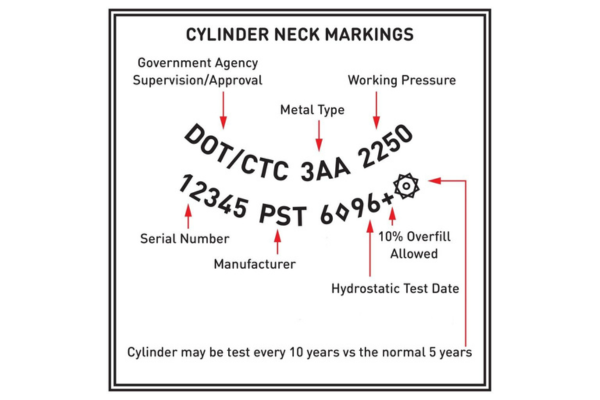
Test markings stamped into the cylinder neck show the original manufacturer date, the most recent retest date, and the testing facility's identification stamp.
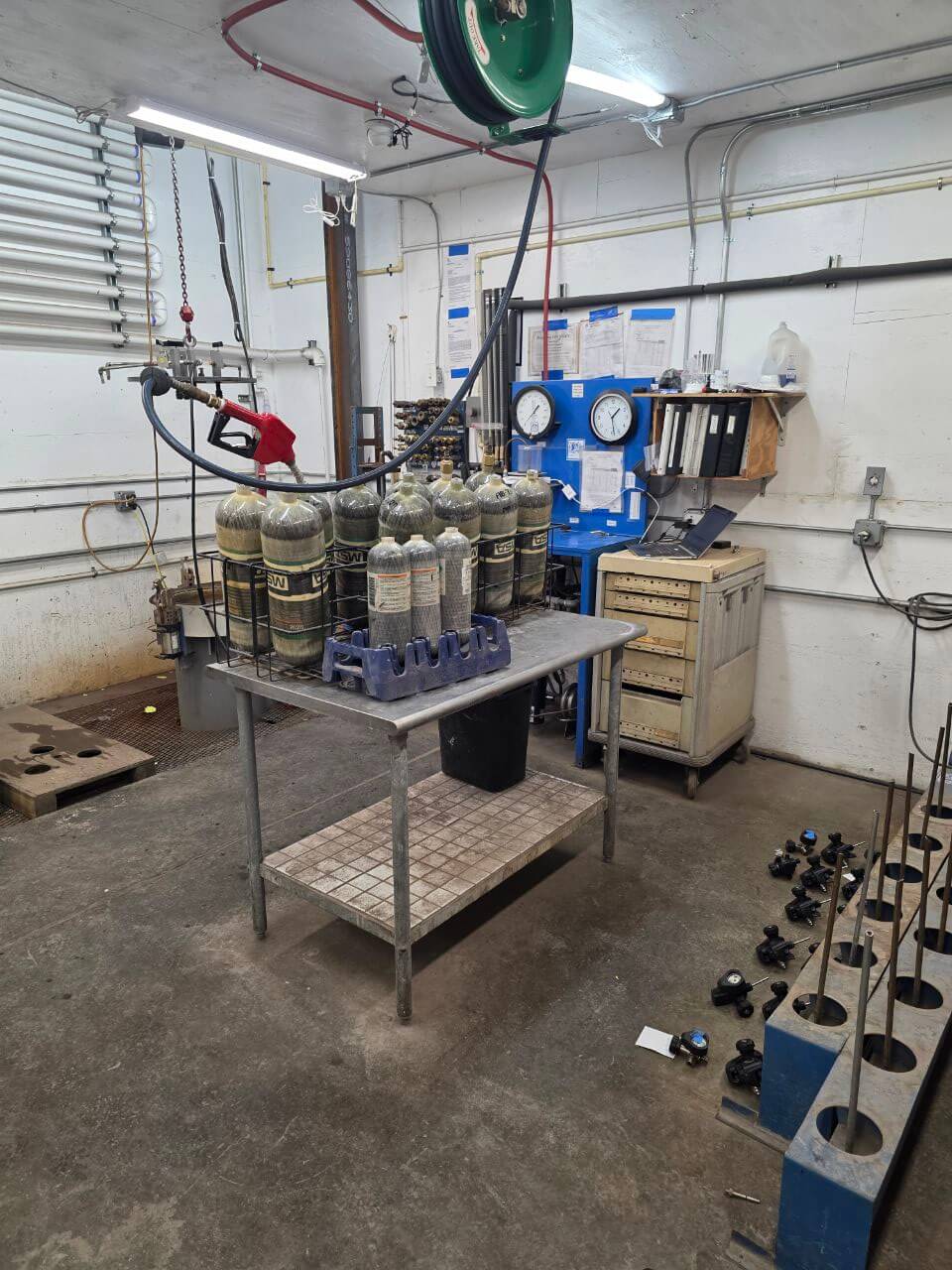
U.S. DOT-Authorized Hydrostatic Testing Facility — RIN D133
Federal hydrostatic testing of fire extinguisher cylinders is regulated by the U.S. Department of Transportation under 49 CFR. Only facilities holding an active Requalification Identification Number (RIN) issued by the Pipeline and Hazardous Materials Safety Administration (PHMSA) are authorized to test, restamp, and return DOT-regulated cylinders to service.
Serviced Fire Equipment holds active DOT RIN D133, authorizing hydrostatic testing on DOT cylinder specifications 3A, 3AA, 3AL, 3HT, 4B, 4B240ET, 4BA, and 4BW — plus 30 active special permits. Every cylinder we test, pass, and restamp is backed by federal authorization that your insurance carrier, AHJ, or fire marshal can verify.
Beyond facility authorization, every technician who handles DOT-regulated cylinders at our shop receives ongoing in-house DOT hazmat training in compliance with 49 CFR §172.704. Training is documented and refreshed on the federal three-year cycle, so the person actually putting your cylinder under pressure is qualified to do so — not just the facility on paper.
Issuing Agency: U.S. DOT / PHMSA
Valid Through: November 22, 2027
Authorized Specifications: 3A, 3AA, 3AL, 3HT, 4B, 4B240ET, 4BA, 4BW
Download DOT Approval Letter (PDF) →
Scope: All technicians handling DOT cylinders
Refresh Cycle: Every 3 years per technician
Records: Maintained on file at our facility
Training records are available for review by AHJs, insurance auditors, and DOT inspectors on request.
Water Jacket Hydrostatic Testing — Step by Step
The water jacket method is the gold standard for hydrostatic testing — and it's the method we use on every cylinder that comes through our shop. Here's exactly what happens between drop-off and pickup.
External Inspection
Before any cylinder gets pressurized, our DOT-qualified technicians inspect the exterior for corrosion, dents, gouges, fire damage, and worn threads. About 5% of cylinders fail visual inspection before they ever reach the test bay — and that's the right outcome. A compromised cylinder shouldn't be tested, it should be condemned.
Per CGA C-6 standards
Water Jacket Test
The cylinder is filled with water and submerged in a sealed water-filled jacket, then pressurized to its DOT-specified test pressure — typically 5/3 of service pressure for high-pressure cylinders (3A, 3AA, 3AL, 3HT) and 3/2 for low-pressure types (4B, 4BA, 4BW). The water displaced by the cylinder's expansion is measured precisely — that tells us whether the cylinder still has the elasticity to handle its rated pressure safely. No guessing, no estimating. Just measured expansion.
DOT 49 CFR §180.205
Stamp & Document
Cylinders that pass get stamped directly into the metal with our facility's RIN D133 identification, the retest date, and the test pressure. The stamp stays with the cylinder for life. Every test is also documented in our records — required by federal law and useful if you're ever asked to verify compliance.
Records retained 7+ years
Condemned, Not Hidden
Cylinders that fail are marked "Condemned" and — with your permission — rendered permanently unable to hold pressure. We don't quietly hand failed cylinders back to customers. A failed hydro means the cylinder is at end of life, and putting it back into service would be dangerous. We'll explain what failed and recommend a refurbished replacement if needed.
No silent failures
Standard Turnaround
7 – 10 Business Days
From drop-off to pickup, on most cylinders. Bring it in, we'll call when it's ready.
Rush Service Available
24 or 48 Hour
Need it back faster? Rush fees available for 24-hour or 48-hour turnaround on most cylinder types.
High-Volume Pricing
Discounts Available
Dive shops, fire equipment dealers, and bulk resellers get tiered volume pricing. Call for a quote.
What Is Hydrostatic Testing, Exactly?
Hydrostatic testing is the federally-mandated way of confirming that a pressurized cylinder is still safe to use. The cylinder is filled with water, sealed, and pressurized well above its normal operating pressure. The test measures whether the metal can still expand under load and return to its original shape — the way a healthy cylinder is supposed to behave.
Pressurized cylinders look indestructible from the outside. They're not. Every time a cylinder is filled, used, transported, dropped, banged into something, or exposed to extreme temperatures, the metal experiences microscopic stress. Most of the time that stress doesn't matter. But over years of use, fatigue accumulates — and a cylinder that was rated to hold 3,000 PSI when it was new might not be rated to hold 3,000 PSI a decade later.
That's the entire point of hydrostatic testing: to catch the cylinders that have quietly become unsafe before they fail in the field.
"A pressurized cylinder that fails outside a test bay doesn't leak — it ruptures. That's the difference between routine maintenance and a workplace incident."
Why Does the Government Require It?
The U.S. Department of Transportation regulates hydrostatic testing because pressurized cylinders are technically classified as hazardous materials. A failed CO₂ cylinder under 1,800 PSI of pressure releases the same energy as a small explosion. A failed SCBA bottle at 4,500 PSI is significantly worse. The test isn't bureaucratic overhead — it's the mechanism that prevents working cylinders from becoming projectiles.
DOT mandates testing at fixed intervals depending on cylinder type. SCBA cylinders, CO₂ beverage tanks, SCUBA tanks, and most high-pressure cylinders test every 5 years. Stored-pressure dry chemical fire extinguishers test every 12 years. Some specialty cylinders fall on different cycles. The retest date is stamped directly into the metal — no excuse for missing it.
What Happens If You Skip It?
Three things, in order of severity:
The cylinder becomes legally unfillable. No reputable gas supplier, fire equipment dealer, or dive shop will refill an out-of-hydro cylinder. They check the stamp before they hook up the fill line, and if the date is expired, they hand it back. This is the most common reason customers walk into our shop — they tried to refill somewhere else and got turned away.
You lose insurance and code compliance. Property insurance policies, fire marshal inspections, and OSHA workplace safety standards all require pressurized equipment to be within its current test cycle. An expired hydro on a fire extinguisher can cause your annual inspection to fail. For commercial properties, that's not a minor issue.
You're operating with unverified equipment. The most important reason isn't legal or financial — it's physical. A 12-year-old cylinder that's never been tested is a 12-year-old guess. Modern cylinders almost always pass hydro testing. But the small percentage that fail are exactly the ones you want to catch in a controlled test environment, not in someone's hands.
Why "Hydrostatic" — Why Water?
Water is used instead of compressed air for one critical reason: water doesn't compress. If a cylinder fails during testing, water-pressurized failure releases minimal energy. The cylinder might split or leak, but it doesn't explode. Compressed-air testing of a failed cylinder, by comparison, would release the entire stored energy at once — which is why nobody does that anymore. Water makes the test safe to perform.
The "static" part means the pressure is held steady at the test value for a defined period — typically 30 to 60 seconds — while measurements are taken. Static pressure under controlled conditions, in a sealed water jacket, with precise expansion measurement. That's the test. It's been refined over decades and it works.
How Long Hydrostatic Testing Actually Takes
Drop off your cylinders at our St. Petersburg shop, we'll handle the testing in-house, and call you when they're ready for pickup. No shipping out, no third-party delays, no surprises.
From drop-off to pickup, on most cylinders. We'll call you when your tanks are ready. No appointment needed to drop off — walk in any time during business hours.
Need it back faster? Rush fees are available for 24-hour or 48-hour turnaround on most cylinder types. Call ahead to confirm capacity for the week.
Dive shops, fire equipment dealers, and bulk resellers get tiered volume pricing. Call us for a quote based on your typical volume.
Outside Tampa Bay?
We also handle nationwide hydrostatic testing for fire equipment dealers and bulk resellers — ship cylinders to our St. Petersburg facility, we test and ship back. Learn more about wholesale →
Hydrostatic Testing for Tampa Bay & Beyond
Our St. Petersburg facility at 3200 62nd Ave N sits just off I-275, putting us within a 45-minute drive of every major Tampa Bay city. Customers regularly bring cylinders to us from across Pinellas, Hillsborough, Manatee, and Pasco counties.
Pinellas County
Hillsborough County
Manatee County
Pasco County & Surrounding Areas
Don't see your city? If you're in Tampa Bay or Central Florida, you're welcome at our shop. We're a drop-off facility — no pickup service — but we'll have your cylinders tested and ready faster than most local alternatives. Call (727) 620-3473 if you have questions before driving in.
Federally Approved for 38+ Cylinder Specifications
As a fully licensed, DOT-approved hydrostatic testing facility (RIN D133), we are authorized by the Pipeline and Hazardous Materials Safety Administration to test the following DOT cylinder specifications. If your cylinder bears any of these markings, we can test it in-house.
Covers high-pressure steel and aluminum cylinders, low-pressure cylinders, and composite-wrapped SCBA bottles.
Special permits cover specialty cylinders that operate outside standard DOT specifications — common in fire suppression, marine systems, and specialty industrial applications.
Don't see your cylinder's specification listed? Check the stamping on your cylinder and call us — many manufacturers cross-list their cylinders under multiple DOT specs, and we may still be authorized to test it.
View DOT Approval Letter (PDF) → Call (727) 620-3473Hydrostatic Testing FAQs
The questions we get most often from walk-in customers, dive shops, fire equipment dealers, and bar managers — answered straight.
How often does my cylinder need hydrostatic testing?+
How do I know if my cylinder is due?+
What happens if my cylinder fails the test?+
Can I refill the cylinder after testing?+
Do I need to empty the cylinder before bringing it in?+
What's the difference between hydro testing and visual inspection?+
Do I need an appointment to drop off cylinders?+
Why is hydrostatic testing required by law?+
Contact us today to schedule your water jacket hydrostatic testing and ensure the safety and compliance of your equipment. Let Serviced Fire Equipment be your partner in protecting what matters most.
Why Choose Us?
– DOT-approved hydrostatic testing facility
– Fast turnaround times with in-house testing
– Experienced technicians handling a wide range of cylinders
– Ability to service, refill, and return cylinders ready for use
We provide a complete solution so your cylinders are tested, documented, and ready to go without unnecessary delays.
Authorized. Certified. Verified.
Every certification below is current, verifiable, and backed by the agencies and manufacturers that issued it.
Federal & International Authorizations
Tier 1Cycle: Every 3 years per technician
State of Florida Licensing
Tier 2Licensed by the Florida Division of State Fire Marshal. Both license numbers below can be verified directly through the State of Florida.
Manufacturer Distributor Authorizations
Tier 3Authorized distributor for the leading names in portable fire extinguishers, pre-engineered restaurant and vehicle suppression systems, and marine fire protection.
Industry Memberships
Tier 4
All credentials above are current and verifiable. To verify Florida Fire Marshal licenses directly with the state, visit the Florida Department of Financial Services license search.
Why Tampa Bay Trusts Us With Their Hydrostatic Testing
Most fire equipment dealers in Florida outsource hydrostatic testing to a third party. We do it in-house. That's the difference, and it shows up in turnaround time, accountability, and the stamp on your cylinder.
Real Turnaround, Not Promises
Standard hydro testing turnaround is 7–10 business days. Rush service available for 24-hour or 48-hour turnaround on most cylinder types. We hit our turnaround windows because the equipment is in our shop, not at a third party — no shipping delays, no scheduling conflicts.
No Outsourcing, No Shipping
When you bring a cylinder to us, it doesn't get shipped to another state for testing. The water jacket rig is in our 10,000 sq ft St. Petersburg facility. That's why we can offer 7–10 day standard turnaround and 24-hour rush — most outsourcing dealers can't match either.
Cylinder Specs Authorized
8 standard DOT specifications plus 30 special permits. From SCBA composite cylinders to beverage CO₂ tanks to specialty marine and industrial cylinders, our DOT authorization covers cylinder types most local dealers can't legally test in-house.
Same Family, Same Shop, Since 1999
Started as a one-man operation out of a storage unit in St. Petersburg. Now a 10,000 sq ft facility serving Tampa Bay walk-in customers and shipping nationwide to fire equipment dealers. Same family, same EIN, operating continuously for over 25 years. Read our story →
Ready to Get Your Cylinders Tested?
Drive to our St. Petersburg facility — just off I-275. Walk in any time Monday through Friday, 8 AM to 4 PM. No appointment needed. We'll have your cylinders tested, stamped, and ready for pickup faster than most local alternatives.